
Helping communities effectively manage water chestnut throughout the Northeast
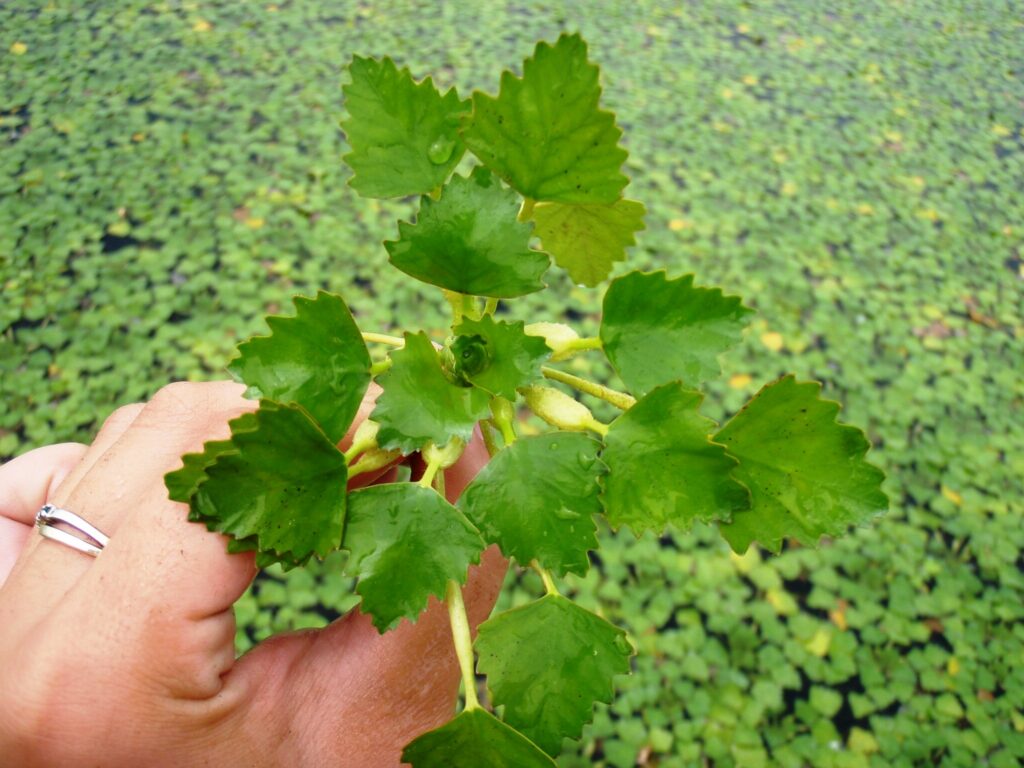
Water chestnut (Trapa natans) is an invasive aquatic plant that grows in freshwater lakes, ponds, and slow-moving waterways. Dense mats of floating leaves can rapidly spread across large areas, outcompeting native plants and blocking sunlight from reaching underwater vegetation, while also reducing habitat quality for fish and wildlife. These mats can also contribute to low dissolved oxygen levels, which can stress or harm aquatic life. Water chestnut infestations can impede recreation and reduce the overall usability of a waterbody, thereby affecting local economies.
Managing Water Chestnut: A Decision Framework and Implementation Guide for Communities
Managing water chestnut can be challenging, particularly when infestations are large or resources are limited. In 2026, NEIWPCC developed “Managing Water Chestnut: A Decision Framework and Implementation Guide for Communities” to help municipalities, watershed organizations, community groups, lake and pond associations, and other waterbody stewards navigate the process of managing this invasive plant. The guide provides a step-by-step framework for:
- Identifying and assessing an infestation.
- Selecting a management approach.
- Planning a volunteer hand-pulling effort or herbicide treatment.
- Monitoring results over time.
The guide was informed by experiences and lessons drawn from water chestnut management efforts in southeastern Massachusetts and Rhode Island, including work conducted in partnership with local communities and organizations. The guide focuses on two management approaches: volunteer hand-pulling and herbicide treatment. Other control methods, such as mechanical harvesting and hydro-raking, are beyond the scope of this resource.
Explore the Guide by Video – COMING SOON!
The approximately 15-minute companion video provides an overview of the full guide, and can be used as a starting point for communities and other waterbody stewards planning a management effort.
Acknowledgments
This project and associated deliverables were supported by Southeast New England Program (SNEP) Watershed Implementation Grants. SNEP Watershed Implementation Grants are funded by the U.S. Environmental Protection Agency (EPA) through a collaboration with Restore America’s Estuaries (RAE).
NEIWPCC thanks the following organizations for their collaboration, review, and contributions:
- Rhode Island Department of Environmental Management (RIDEM)
- Massachusetts Department of Environmental Protection (MassDEP)
- Blackstone River Watershed Council (BRWC)
- Blackstone Valley Tourism Council (BVTC)
- Blackstone Watershed Collaborative (BWC)
- Lake Quinsigamond Watershed Association (LQWA)
- City of East Providence, Rhode Island
- City of Worcester, Massachusetts
- Town of Grafton, Massachusetts
- NEIWPCC Executive Committee and Commissioners
NEIWPCC acknowledges the continued efforts of regional partners, municipalities, and volunteers working to manage water chestnut and protect aquatic resources throughout the Northeast.
Learn more about aquatic invasive species.
For more information, contact Maryann Dugan at mdugan@neiwpcc.org.