
-
Combating Our Aging Wastewater Workforce
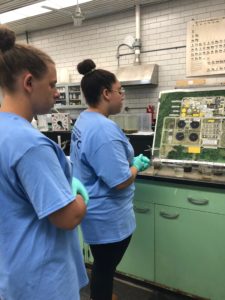
As the United States’ wastewater workforce ages, the need for new operators entering the industry is becoming critical. In its document, “America’s Water Sector Workforce Initiative: A Call to Action,” the EPA Office of Water highlights the issue: “One of the major challenges facing our nation is the critical and unprecedented staff shortage in the…
-
Dam Removal Improves Water Quality, Flood Resilience, and Fish Habitat
In August 2021, the Lake Champlain Basin Program worked with the Franklin County Natural Resources Conservation District to oversee the removal of the Johnsons Mill Dam, located along the Bogue Branch in Bakersfield, VT. After decades of disuse, the stone and concrete dam was in a state of deterioration and recommended for removal by the…
-
Tracing the Pandemic Through our Wastewater
“The sewer is the conscience of the city.” Phyllis Rand, of the Greater Augusta Utility District, shared this quote from Victor Hugo’s “Les Misérables” during a recent training on wastewater-based epidemiology. Rand emphasized how pollutants, diseases, and other materials in our wastewater are valuable data that tell stories about a community. In the last two…
-
Creating Valuable State-Tribe Communications
During the Meaningful State-Tribe Communication webinar – the latest installment of the EPA-funded National 303(d)/TMDL Webinar Series – relationship building emerged as a common theme from the three speakers. Held on Sept. 29, the panelists included Bruce Jones of the Northwest Indian Fisheries Commission (NWIFC); Nancy Schuldt of the Fond Du Lac Band of Lake…
-
Lake Champlain Basin Program Seeks Proposals for Projects to Improve Water Quality
The Lake Champlain Basin Program (LCBP), a NEIWPCC program partner, has announced a request for technical pre-proposals for services to further the goals and objectives of the Lake Champlain management plan, “Opportunities for Action.” The total request for each project may range from $25,000 to $300,000 with an anticipated start date of early 2023. Applicants may…
-
Funding Available for Economic Feasibility of Commercial Bioextraction in the Long Island Sound
NEIWPCC, in cooperation with the Long Island Sound Study, the New York State Department of Environmental Conservation, and its partners, is inviting proposals for an economic study on nutrient bioextraction within the Long Island Sound. This project will determine the feasibility of commercial bioextraction using seaweed and/or shellfish in the New York and Connecticut sections…
-
Fall Issue of “Interstate Waters” Explores Wastewater-Based Epidemiology
The Fall 2021 issue of NEIWPCC’s “Interstate Waters” is now available, in both digital and print formats. The lead story focuses on wastewater-based epidemiology, examining how researchers and public health officials are tracing the spread of COVID-19 through wastewater. Readers can also learn about the upcoming wave of retirements in the wastewater workforce, which will…
-
EPA Recognizes NEIWPCC Commissioners and Partners with Regional Environmental Awards
For more than 50 years, the U.S. Environmental Protection Agency (EPA) New England has recognized those who have made outstanding contributions to protect the region’s environment. The 2021 Environmental Merit Awards, presented in a virtual ceremony on Sept. 14, included several NEIWPCC partners. Former NEIWPCC Commissioner Janet Coit was honored with the Ira Leighton “In…
-
Three Projects Announced to Help Protect Hudson River Estuary
The New York State Department of Environmental Conservation (NYSDEC) has announced $349,922 in contract awards for three projects to help communities improve climate resiliency, mitigate local flooding, and restore aquatic habitats. Funding for these projects is provided by the New York State Environmental Protection Fund and is administered by NYSDEC’s Hudson River Estuary Program in…
-
Youth Explore the Hudson through Environmental Research Program
Fifteen high school and college students from communities across the Hudson Valley recently completed an innovative two-week research program together with education staff and scientists at the Norrie Point Environmental Center in Staatsburg, NY. Through The Institute Discovering Environmental Scientists (TIDES) program, students conducted environmental research projects along the banks of the Hudson River and in freshwater…