
-
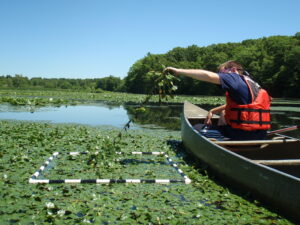
Water Invaders: A Spotlight on Aquatic Invasive Species
By Beth MacBlane On a humid July morning before the sun peaks, a duo of paddlers push off the sandy shore of Lake Washington in Rhode Island, slowly gliding in their canoe toward the lily pads and grassy reeds in search of ecologically disruptive non-native plants. These seasonal water quality technicians, with the state’s Department…
-
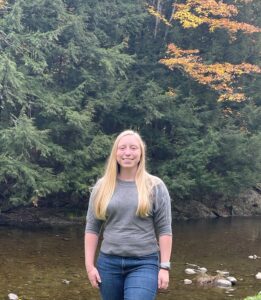
Federal Funding for Nonpoint Source Implementation Projects: The 319 Grant Program for States and Territories
Episode seven of the “Clean Water Pod” podcast explores the 319 Grant Program, established by the 1987 amendments to the Clean Water Act to support state, territory and tribal nonpoint source implementation projects. Host Jeff Berckes speaks with Steve Konrady, western Iowa basin coordinator for the Iowa Department of Natural Resources Water Quality Bureau, and…
-
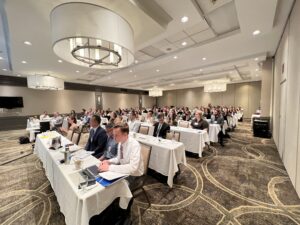
Annual Nonpoint Source Conference Focuses on Environmental Justice
The 33rd Annual Nonpoint Source (NPS) Conference was held on April 12-13 in Saratoga Springs, New York, drawing more than 120 attendees representing professionals and stakeholders from across the country. The conference focused on NPS pollution and its effects on the environment, with an overarching theme of “Environmental Justice, Equity, and Climate Change.” The event…
-
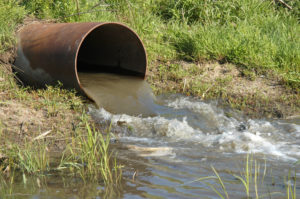
Permitting Point Source Pollution
Episode 6: The National Pollutant Discharge Elimination System (NPDES) Permit Program The sixth episode of the “Clean Water Pod” podcast explores the Clean Water Act’s National Pollutant Discharge Elimination System permit program, commonly referred to by its acronym, “NPDES.” To discuss how this program improves water quality, host Jeff Berckes is joined by guests Jeff…
-
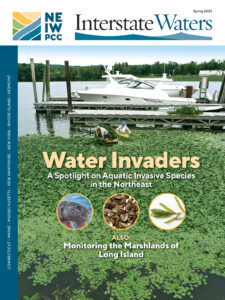
Spring Issue of Interstate Waters Spotlights Aquatic Invasive Species
In the Spring 2023 issue of Interstate Waters, NEIWPCC shines a spotlight on the devastation of aquatic invasive species, and the efforts of staff throughout the Northeast to monitor, control and reduce the spread in a waterbody. The article explores social and economic impacts, strategies to mitigate the damage, and takes a closer look at…
-
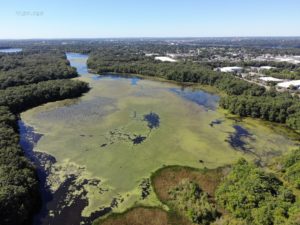
SNEP Funding Supports Water Chestnut Management in Rhode Island and Massachusetts
The Southeast New England Program (SNEP) awarded NEIWPCC a $262,077 grant for habitat restoration efforts in two interstate watersheds. The project, Community-Based Habitat Restoration: Water Chestnut Management in the Blackstone and Ten Mile Watersheds, will launch in the spring of 2023. Both the Blackstone and Ten Mile watersheds are located in southeastern Massachusetts with sections…
-
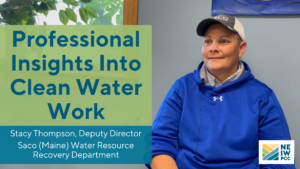
New Video Spotlights Wastewater Career Journey
Stacy Thompson, deputy director of the Saco (Maine) Water Resource Recovery Department shares how she unexpectedly entered the clean water industry and what she loves about her career in this new video. Thompson, who is also a NEIWPCC Commissioner, admits that working at a water resource recovery facility was not something she had planned on.…
-
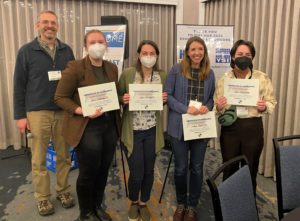
Northeast Aquatic Biologists Conference Cultivates Collaboration Among Environmental Community
The 2023 Northeast Aquatic Biologists (NAB) Conference convened for its annual regional event in Plymouth, Massachusetts in February. Participation surpassed pre-pandemic numbers, with 152 attendees from all seven of NEIWPCC member states’ environmental departments, the U.S. EPA, and United States Geological Survey (USGS), academic institutions, and the private sector. Deneen Simpson, director of Environmental Justice…
-
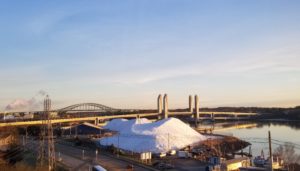
Chloride Resources Clearinghouse Aims to Reduce Salt Concentrations in the Environment
In the Northeast, winter weather has become associated with one particular pollutant: salt. When snow and ice hit the ground, de-icing salts (comprised of chlorides) are scattered liberally across roads, sidewalks and driveways to melt ice. Salt provides a valuable service in the wintertime by improving the safety of roads and walkways, but overapplication can…
-
Calculating Pollution Tipping Points: Total Maximum Daily Loads (TMDLs)
In episode five of the “Clean Water Pod,” podcast host Jeff Berckes digs into his favorite four-letter word: TMDL, or Total Maximum Daily Load. Part equation and part plan, a TMDL defines the maximum amount of a specific pollutant allowed in a waterbody for it to meet designated water quality standards. It serves as a…