
ASTM’s Standard for Moving Petroleum Release Sites to Closure (MStC) is Published
Note to Reader: The MStC standard was published in May 2025, and now EPA and ASTM are focusing on outreach and training. The 2023 LUSTLine article, “Into the MStC – Developing A New Standard for Moving Petroleum Release Sites to Closure” (LUSTLine # 93), describes some of the historical and scientific bases the MStC Task Group relied on when developing the standard. If you haven’t read that article, please go back and read it before diving into this article.
Introduction
Since its inception, the national Underground Storage Tank program has completed more than 527,000 UST cleanups. Through these efforts, we have learned a lot about keeping drinking water safe and preventing petroleum vapors from entering confined spaces and indoor air. Approximately 54,000 sites remain to be cleaned up nationwide, with the potential for more release discoveries as facilities close or replace their USTs. It is going to take our best collective efforts to resolve these old cases and to keep up with new release discoveries. As part of these collective efforts, ASTM recently published the “E3488-25 Standard Guide for Moving Sites to Closure (MStC) for Petroleum Underground Storage Tank (UST) Releases” to help implementing agencies complete the remaining cleanups. A 90-person Task Group of stakeholders from the petroleum cleanup community — regulators, scientists, owners, Tribes, insurance, and state funds — worked through ASTM’s consensus-building process to develop the final MStC standard.
Summary
“ASTM E3488-25 Standard Guide for Moving Sites to Closure (MStC) for Petroleum Underground Storage Tank (UST) Releases” is now final and can be previewed and purchased online. MStC provides a framework, based on the latest science and best practices, for moving open petroleum UST releases to closure. It is a protective approach that focuses on addressing exposure to human and ecological receptors. It has sections on assessing the adequacy of the conceptual site model, evaluating alternative closure criteria, overcoming non-technical barriers, and assessing cleanup progress and determining when to change strategy.
EPA and ASTM are providing introductory webinars and workshops for states, Tribes, and other stakeholders that are interested in learning more about MStC. If you would like to learn more about MStC or schedule training, please reach out to me.
The U.S. Environmental Protection Agency developed a companion policy statement, “Reassessing Exposure Threats from Petroleum Underground Storage Tank Releases,” to encourage UST cleanup programs to take a fresh look at the threats posed by their open petroleum UST releases. Assessing current exposures helps identify higher threat sites that may need additional attention and low-threat sites that may be suitable for closure. This policy statement provides broad guidelines that implementing agencies can tailor to their UST programs. It can help implementing agencies focus time and resources on higher priority releases and increase the number of UST release sites progressing toward closure. The policy statement refers to the MStC framework as one possible approach for incorporating threat assessments into corrective action programs.
At a Glance…Possible UST Cleanup Program Benefits From Adopting the MStC Standard
- A fresh look at open cases identifying previously unrecognized exposures and improving corrective action decisions.
- Improving communication through exposure evaluations.
- Closing low threat release cases in states with groundwater non-degradation cleanup goals.
- Improving understanding of closure criteria.
- Allowing alternative closure criteria for more efficient corrective actions.
- Scientifically based LNAPL control requirements leading to more efficient corrective actions.
- Decreasing long-term monitoring costs and allowing programs to focus resources on releases that pose exposure threats.
- Optimizing remedies and bringing cases closer to completion.
How Does the MStC Standard Work?
The MStC standard offers a framework for overcoming technical and non-technical barriers to closure and improving cleanup strategies. This includes:
- Technical obstacles such as issues with the Conceptual Site Model (CSM), closure criteria, and ongoing exposure threats.
- Non-technical obstacles such as site access, lack of a viable owner/operator, or a lack of funding.
- Techniques for evaluating the effectiveness of current remedies and developing improved remedies.
The standard is flexible, allowing implementing agencies to adopt and implement the framework wholly or partially. Additionally, implementing agencies can adjust the recommended closure criteria to their needs.
How Might the MStC Standard Benefit My Program?
The MStC standard is a practical framework that implementing agencies can adopt and adapt to help bring UST releases to closure. It is based on current science and best practices developed from completing 527,000 UST release cleanups since 1988.
Adopting the MStC framework could lead to major changes and improvements in UST corrective action programs. Every UST cleanup program in the U.S. and around the globe is different and corrective action processes vary, so adopting MStC will affect each program differently. Some of the major changes and potential benefits for UST corrective action programs include:
- A fresh look at open cases identifying previously unrecognized exposures and improving corrective action decisions. Reexamining open release cases with current scientific knowledge and best practices helps ensure exposures are being fully recognized and managed. The cleanup goals for many open release cases were established over 20 years ago, based on a limited understanding of the sources, pathways, and receptors, and the potential for petroleum natural attenuation. Previous assessments might have overlooked an exposure such as vapor intrusion. A fresh look will often improve decision making, whether the examination shows a need for additional remediation or no further action.
- Improving communication through exposure evaluations. Increasing transparency and openness during the exposure evaluation process leads to better dialogue and collaboration among the involved parties, especially with complex release cases. Communication is critical when implementing agencies decide to close cases that have not met initial cleanup goals but where it is now clear there is a low threat of exposure. Providing an open and transparent process facilitates meaningful stakeholder understanding and contribution.
- Closing low threat release cases in states with groundwater non-degradation cleanup goals. The MStC framework allows a pathway to closure for states with groundwater non-degradation statutes assesses the potential threat of exposure to human and ecological receptors while natural attenuation degrades the remaining petroleum. Natural attenuation can be as effective or more effective than active remediation at a certain point in a release life cycle and long-term monitoring is not needed once it is clear that the plume is stable and not reaching receptors. This approach can be consistent with groundwater non-degradation statutes, which typically require cleanup of groundwater contamination to drinking water standards and remediating soil that could be a source of groundwater contamination.
- Improving understanding of closure criteria. Alternative closure criteria may be descriptive and easier to interpret than concentration-based closure criteria (such as 5 ppb benzene in groundwater samples). For example, non-groundwater professionals can more easily understand descriptive and visual metrics for closure criteria like plume stability and buffer distances. A simple paragraph can provide a clear, understandable picture of the contamination, its behavior, and a buffer distance from the leading edge of the plume to potential receptors.
- Allowing alternative closure criteria leads to more efficient corrective actions. For example, MStC allows demonstration of groundwater plume stability by either groundwater concentration trends or plume retraction. Trend analysis is a widely used technique, but use of plume retraction has not been widely reported. Trend analysis involves evaluating the concentrations of chemicals of concern in groundwater, as well as assessing the effects of fluctuating (rising and falling) groundwater levels. Plume retraction is a snap-shot assessment of where biodegradation has occurred past the leading edge of the dissolved petroleum — the extent of the plume was once larger and is now decreasing. Plume retraction can be demonstrated in one site visit and thus may be more convenient at sites that do not have monitoring wells. Either method may be appropriate depending on site circumstances. The MStC standard allows flexibility to select the most efficient demonstration method.
- Scientifically based LNAPL control requirements leading to more efficient corrective actions. There has been a long-standing debate among petroleum remediation professionals regarding the significance of LNAPL accumulating in monitoring wells. In the MStC framework, it may be acceptable to leave residual and mobile LNAPL in the ground if they are not causing a vapor intrusion concern or an expansion of groundwater plumes. Some implementing agencies prohibit closure at sites where LNAPL continues to accumulate in monitoring wells. If this prohibition were removed, it would represent a significant program policy change and may remove a significant barrier to closing sites.
- Decreasing long-term monitoring costs and allowing programs to focus resources on releases that pose exposure threats. The benefits of long-term monitoring in the natural attenuation process have been debated for years. The MStC framework does not require monitoring once the stability of the release has been demonstrated. No one in the 90-person Task Group could recall an instance where monitoring of a naturally attenuating plume led to discovery that the plume was once again expanding or that active remedies were needed.
- Optimizing remedies and bringing cases closer to completion. Remediation efforts often outlive their usefulness, becoming inefficient or unnecessary. Implementing the MStC framework allows for increased assessments of remediation effectiveness and change to a more effective remedy.
How Can I Learn More About MStC?
While this article provides an overview of the MStC standard, there will be many more opportunities to learn about it. Some of the outreach initiatives include:
- Articles about MStC-related activities are coming out soon.
- EPA and ASTM are providing awareness training for state UST programs. This initiative also includes comprehensive 3-4 hour workshops scheduled for various conferences and national meetings.
- EPA and ASTM are developing a generic 2-day training program for UST remediation stakeholders (regulators, owners, cleanup consultants, and other relevant parties) that can be tailored to individual state UST remediation programs.
Some states have already expressed interest in learning more about MStC and EPA’s Exposure Threat Assessments policy and two state UST programs have said they want to adopt MStC. All states are encouraged to take advantage of the learning opportunities and determine if MStC and exposure threat assessments will help their program and identify whether changes in guidance, regulations, or statutes might be needed to implement the changes. Please write me if you would like to learn more about MStC training opportunities.
More About the MStC Standard
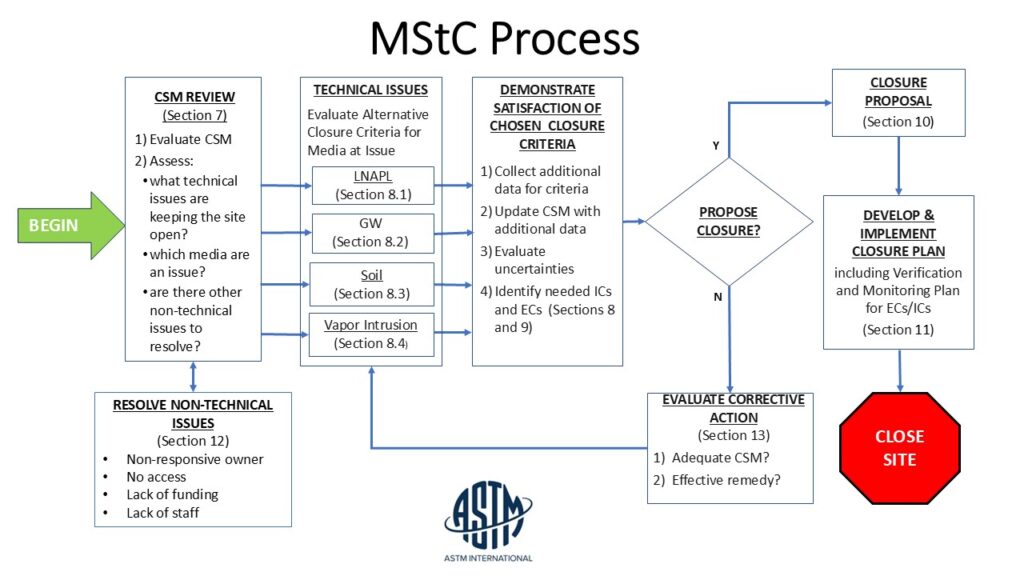
This section of the article describes the MStC process and the key sections of the MStC standard. I encourage you to look at the standard in its entirety after reading this article, and to reach out to me with any questions.
Conceptual Site Model (CSM)
The first step in the MStC process is to determine if the CSM is complete enough to understand the threats to receptors and to make corrective action decisions with confidence. The questions below help the User to determine if their CSM is complete enough to evaluate alternative closure criteria and remedy effectiveness:
- Are any receptors currently exposed to the release? If yes, what type of receptors?
- Is there a potential for exposures to receptors, including anticipated future receptors? Is there a potential for LNAPL migration?
If the answer to any of the LNAPL and receptor exposure questions above is “Yes,” then ask:
- Are dissolved groundwater contaminants likely to migrate to current and anticipated future receptors? In other words, do pathways and a sufficient mass of contaminants exist for the dissolved groundwater contamination to reach current and potential receptors?
- If there is a likelihood of remedial action, what subsurface characteristic could affect removal or treatment of the LNAPL, soil vapor, and groundwater contamination?
Technical Barriers and Alternative Closure Criteria
The next step is to identify and address technical concerns that are preventing closure, such as not meeting target cleanup concentrations in groundwater. The standard helps determine if the release poses a low threat of exposure to human and ecological receptors by comparing site conditions. The site must meet the following four minimum conditions before considering alternative closure criteria:
- The release has stopped.
- There are no current impacts to receptors.
- LNAPL is not migrating.
- There is a basic CSM.
MStC provides information on each alternative criteria to help identify the criteria that are most appropriate for demonstrating that a site poses a low exposure threat. Using this criterion is essential for a cost-effective assessment. For example, the five peer reviewed criteria listed below demonstrate that LNAPL is not migrating.
- Decreasing LNAPL extent thickness (gauging) demonstrated by a trend analysis in the CONCAWE LNAPL Tool Kit.
- Stable or decreasing groundwater plume.
- Residual LNAPL located beyond the footprint of mobile or migrating LNAPL.
- LNAPL transmissivity low – for example, less than 0.8 ft2/day.
- Residual LNAPL in the soil immediately outside a monitoring well is much thicker than the gauged LNAPL thickness (e.g., greater than five times thicker).
Considering mobile and residual LNAPL (evaluation of groundwater, soil, and soil vapor) is the next step for identifying low-threat conditions. Each assessment should be made separately for groundwater, soil, and vapor intrusion and be based on three classes of criteria.
- Distance screening. Implementing agencies use screening distances for vapor intrusion and direct soil contact. The MStC framework includes screening distances for groundwater receptors as measured from the leading edge of stable plumes to current or future receptors. The California State Water Resources Control Board (SWRCB) Low Threat Closure Policy applies screening distances of 250 to 1,000 feet depending on the presence of mobile LNAPL, the contaminant of concern (COC) plume length, record of plume stability in areal extent, and the maximum COC concentration.
- Measurement of contaminant concentrations. Concentration-based closure criteria involve the evaluation of COC concentrations in groundwater, soil, or soil gas. A site project manager could assess the natural attenuation rate in groundwater or soil to determine if corrective action levels will be achieved within a reasonable time period or prior to the expected use of any potentially affected media.
- Mass flux/discharge modeling. Mass (flux/discharge) of COCs in media are below levels that prevent COC concentrations from exceeding background or corrective action levels at points of exposure. Mass flux/discharge estimates generally require a detailed understanding of:
- Spatiotemporal variabilities of COCs in groundwater.
- Mass flux/discharge (either measured or modeled).
- Rates of groundwater flow within specific hydro-stratigraphic units.
The certainty of mass flux/discharge estimates generally improves with increasing data collection and additional site assessments, particularly for large releases in complex geologies.
The standard provides considerations for institutional controls (ICs) and engineering controls (ECs) for each media. In addition, a section is devoted to general considerations for EC and IC implementation o and summarizes applicable portions of more detailed ASTM standards. MStC also includes a checklist for assessing whether certain ECs and ICs will adequately achieve the stated goals.
Non-Technical Barriers to Closure
Often non-technical issues, such as non-responsive owners and lack of site access, prevent an open release site from progressing to closure. Resolving non-technical issues takes time and effort but is imperative to moving the site remediation forward. These barriers rarely resolve themselves and often become more difficult with the passage of time. The MStC standard provides a checklist of barriers that are divided into 16 categories. This should help implementing agencies track barrier prevalence and group sites by barrier type. Tracking and grouping these non-technical barriers helps implementing agencies resolve the barriers efficiently.
The standard also includes best practices for resolving non-technical issues that implementing agencies have encountered over time. MStC encourages owners, operators, regulators, consultants, development officials, lenders, and investors to work together to overcoming non-technical barriers.
Corrective Action Evaluation
The Corrective Action Evaluation section of MStC outlines the process and tools for evaluating corrective action when conditions do not either allow closure under alternative criteria or the site is not ready for closure. Corrective action, including the CSM, cleanup goals, and remedies, can then be modified to move the site towards closure. When there are CSM uncertainties or when the responsible party is unwilling to commit to long-term engineering or institutional control monitoring obligations all parties involved (i.e., the owner, regulator, and other stakeholders) should evaluate the corrective action and create a plan that addresses concerns that are preventing closure. The plan will identify measures to better achieve the corrective action goals. Elements of the plan could include:
- Filling any data gaps in the site CSM.
- Aligning the corrective action and closure goals.
- Reducing uncertainty in remedial concerns and objectives.
- Assessing corrective action performance.
- Gathering metrics to support transitioning corrective action approaches. Transition points might include transition from active to passive remediation or reducing or eliminating monitoring.
- Using available tools to inform corrective action decision making.
- Reviewing the corrective action to determine if regulatory endpoints are attainable, or whether alternative closure approaches are warranted.
And, like the other sections of MStC, an example checklist is included to summarize the Corrective Action Evaluation.
Conclusion
With nearly 54,000 UST release sites, and the possibility of many more release discoveries in the future, the UST community has significant work to do to move corrective actions toward closure, reduce the number of open releases, and ensure that cases with unresolved threats are addressed.
ASTM’s MStC standard is a comprehensive framework for addressing UST release sites. Adopting the standard may provide substantial benefit to your cleanup program in terms of ensuring protective cleanups, realizing resource efficiencies, and improving stakeholder relationships.
EPA, ASTM and other partners are committed to offering quality training opportunities for implementing agencies. Please reach out to me at Schruben.Thomas@EPA.gov for more information.
Live Webinar
Wednesday, February 18, 2026, 2-3:00 p.m. EST
Into the MStC: ASTM’s E3488-25 Standard Guide for Moving Sites to Closure (MStC) for Petroleum Underground Storage Tank (UST) Release
Sponsored by: U.S. EPA Office of Underground Storage Tanks (OUST)
Author

Issue: #96 | View Archives
Connect With Us

Sign up for our monthly
e-newsletter

