
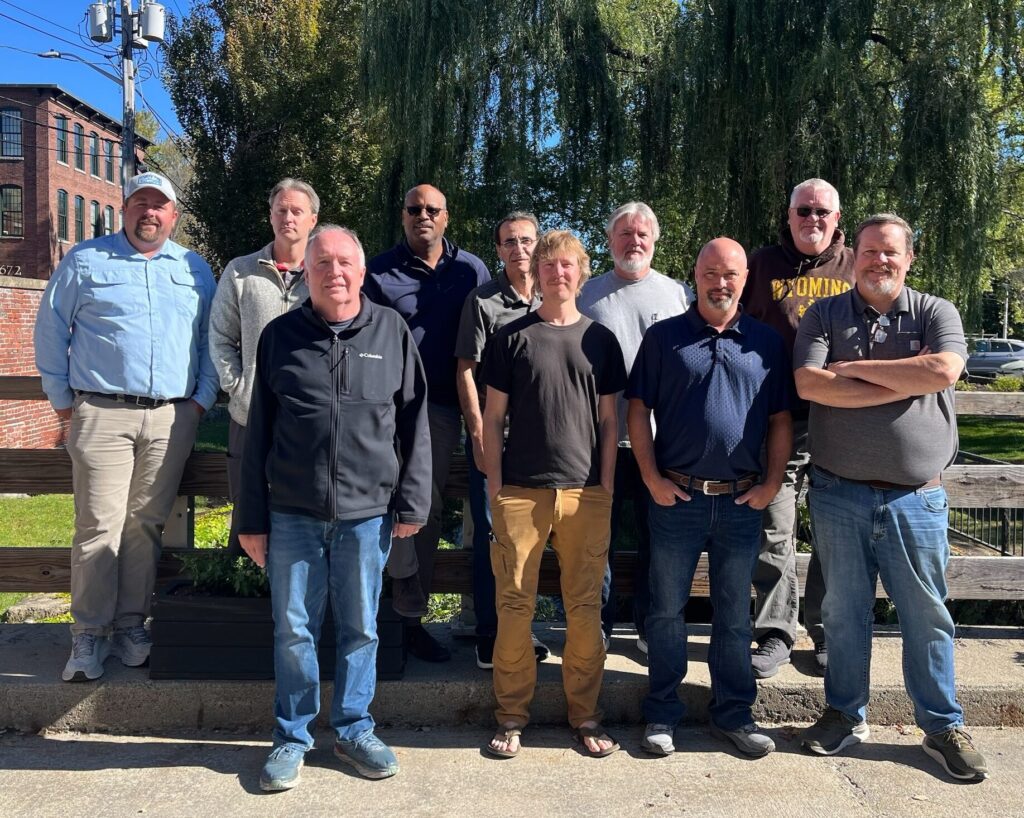
NEIWPCC recently hosted a 3-day in-person meeting for the National Workgroup of Leak Detection Evaluations (NWGLDE) at the Lowell, Massachusetts headquarters. The workgroup evaluates the testing protocols for leak detection equipment used to prevent petroleum releases in underground storage tanks.
During the meeting, participants collaborated on new technologies, website updates, and upcoming projects, including a release detection monitoring report evaluation which is expected to be published next spring. The guidance will examine the changing UST industry and make recommendations for future testing protocols, given the emergence of alternative biofuels and increasing tank sizes.
“We are taking all of our knowledge as a collective group and putting it into this document,” said Tim Smith, a long-time NWGLDE member who works at the EPA as an environmental protection specialist. “Everything has a shelf-life and it is time to reevaluate some of these systems.”
The meeting also included a session where NWGLDE members shared information about their workgroup, evaluation records, and upcoming guidance with NEIWPCC’s Region 1 UST Workgroup, which was also convened in the office on one of the days.
“This was a unique opportunity for the larger tanks community to understand firsthand how complex and critical their work preventing leaks is by ensuring that leak detection methods are properly vetted and reviewed,” said James Plummer, a NEIWPCC environmental analyst who serves as the UST/LUST program coordinator and leads the Region 1 UST Workgroup.
The NWGLDE workgroup was created in 1993, after the Environmental Protection Agency (EPA) passed regulations stating that all underground storage tanks (USTs) installed before 1988 must be equipped with leak detection technology to prevent unintended petroleum releases. Before these systems were widely dispersed, third-party testing needed to be conducted to ensure they were capable of properly detecting leaks. In response, the EPA established minimum criteria for these evaluations to ensure that the equipment meets performance standards.
“The EPA put this guidance out there, but did not have manpower to enforce it,” said Smith.
Don Taylor, the group’s current chair and an environmental fellow at the Tennessee Department of Environment and Conservation, said that the idea for NWGLDE was originally conceived on a cocktail napkin during discussions at a hotel about the need for a group to review third-party testing. The workgroup took on the responsibility of reviewing leak detection system evaluation submissions to determine if each was performed in accordance with an acceptable leak detection test method protocol, on behalf of all the states.
NWGLDE currently consists of 11 state and federal employees from all over the country who work full-time to regulate storage tanks. Within the workgroup, members split themselves into smaller teams to focus on evaluations for various systems that align with their specialties such as automatic tank gauging and volumetric tank tightness tests; aboveground and storage bulk tank methods; secondary and spill containment methods; and line leak detection methods.
While the workgroup does not perform the evaluations themselves, they are experienced in the procedures used by third-parties to test the leak-detection equipment. These product evaluations are usually performed in a lab setting, where leaks are simulated to gauge the effectiveness of the detection software. In addition to tank monitors, NWGLDE also examines test reports for consoles, probes, and sensors.
One of the main outputs of the group is to maintain a list of leak detection methods that are third-party certified to meet EPA and other regulatory performance standards and have been reviewed by the workgroup. This information is made publicly available online to interested parties and contains information on the evaluation methods of products by various vendors, including the date that testing occurred. NEIWPCC works with NWGLDE to maintain these records on its website.
Leaking USTs can result in serious environmental and health risks, including the contamination of groundwater that is a source of drinking water for nearly half of all Americans, according to the EPA.
“Ninety-nine percent of the time, leak detection software does its job,” said Taylor. “But when it does not, the leak keeps going. So, the sooner we can find it using the software, the better.”