
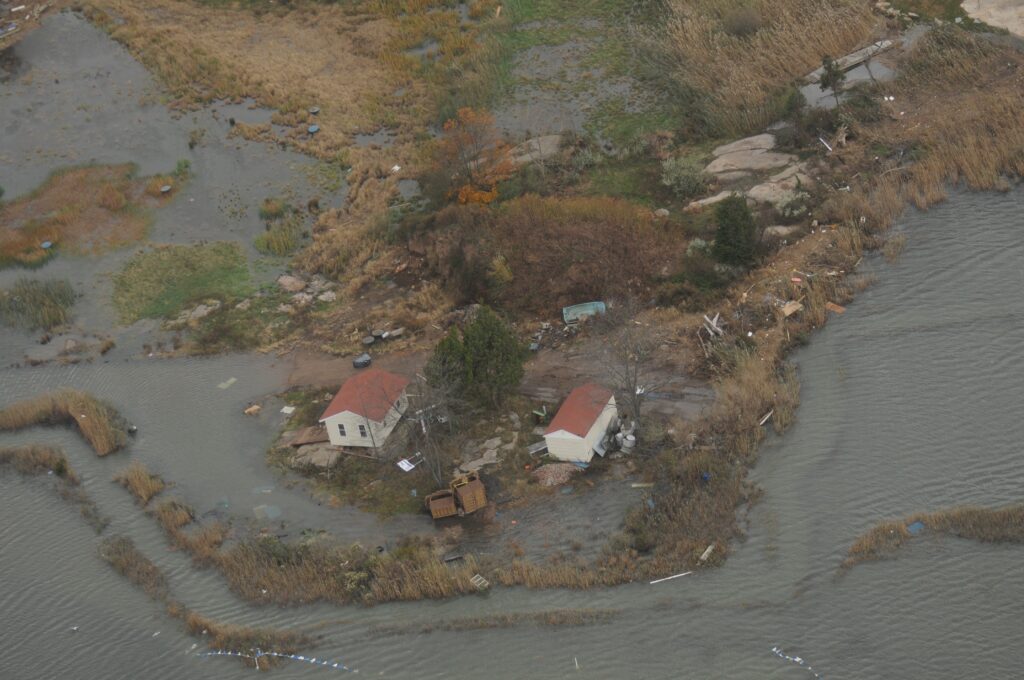
In late October of 2012, Hurricane Sandy slammed into the Northeast, battering neighborhoods across Connecticut, New Jersey, and New York with storm surge, flood waters, and heavy winds. In its wake, the storm left a trail of significant beach erosion and nearly $70 billion in damages to the East Coast, according to the Nature Conservancy. The Army Corps of Engineers reported restoring roughly 15 million cubic yards of sand to existing beaches, which is equivalent to more than a million loads on a dump truck.
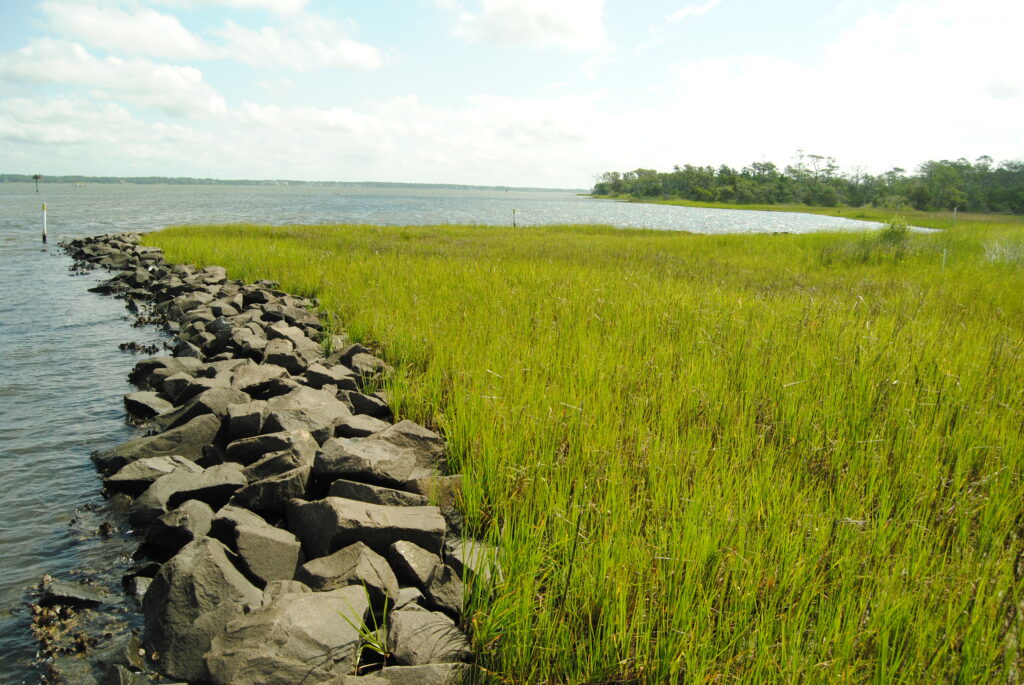
When recovery efforts began, many coastal planners realized that new strategies would be necessary to create resilient shorelines that could withstand future storms and sea level rise. One solution was developing living shorelines, a method to stabilize coasts and protect against erosion using natural elements like plants, sand, rock, and oyster shells.
“Living shorelines are the intersection of ecosystem function, sustainable engineering, and natural aesthetic,” said NEIWPCC Environmental Analyst Alex DuMont.
These presented an alternative to rebuilding collapsed gray infrastructure (like seawalls and bulkheads) which serve to protect human developments. Gray, or hard, infrastructure can often unintentionally increase the pace of erosion by reflecting wave energy back onto the coast. Living shorelines work with the land, rather than against it, by strengthening coastal ecosystems while still providing necessary protections against flooding and erosion.
How Living Shorelines Work
“Picture yourself standing on the shore of an ocean bay looking out towards the water. In front of you are colonies of cordgrass, swaying as they absorb wave energy,” says DuMont. He describes a scene where herons and people fish alongside each other in a tidal creek that snakes its way through the marsh. “Now imagine that instead of that salt marsh, there is just a seawall or bulkhead. Think of all the biodiversity that is lost.”
The premise behind living shorelines is to restore or mimic natural elements such as coral reefs, vegetation, dunes, and rocky areas to reduce wave energy before it reaches the shore. In the past, coastal areas had natural resilience to erosion due to marsh and dune habitats that stood between the waves and inland areas. Over the last several decades, many of these habitats have been lost due to continuing human development in coastal areas and the increasing use of hardened gray infrastructure to protect coastal property. This has resulted in a phenomenon called “shoreline squeeze,” where coastal wetlands are caught between rising sea levels and human development, removing their ability to naturally adapt and migrate.
Living shorelines restore this natural transition between land and water. Using a variety of natural and engineered elements, these projects can stave off the worst impacts of erosion, while strengthening wetland habitats that can store floodwaters — all while providing safety and security for nearby communities.
Design
There is no one blueprint for how a living shoreline should be designed. In fact, each project is tailored specifically to each site. The first step is to determine the suitability of the location for a living shoreline project. Ideal spots will have moderate levels of wave energy such as estuaries, bays, and other sheltered shorelines. Additionally, these techniques can be used on non-tidal waterbodies like lakes and ponds if erosion poses an issue. Areas with heavy wave action, like the open ocean, generally cannot provide enough protection to allow natural components to take root and grow. Places facing extreme and immediate flooding risks may be better served by using hardened infrastructure.
Planners evaluate various factors along suitable sites, including slope, boat traffic, erosion, currents, natural habitats, and land use, to determine the most effective elements for that location. The National Oceanic and Atmospheric Administration (NOAA) recommends using the softest approach feasible (such as native plants, sand, and organic matter) to stabilize shorelines, based on the site’s condition.
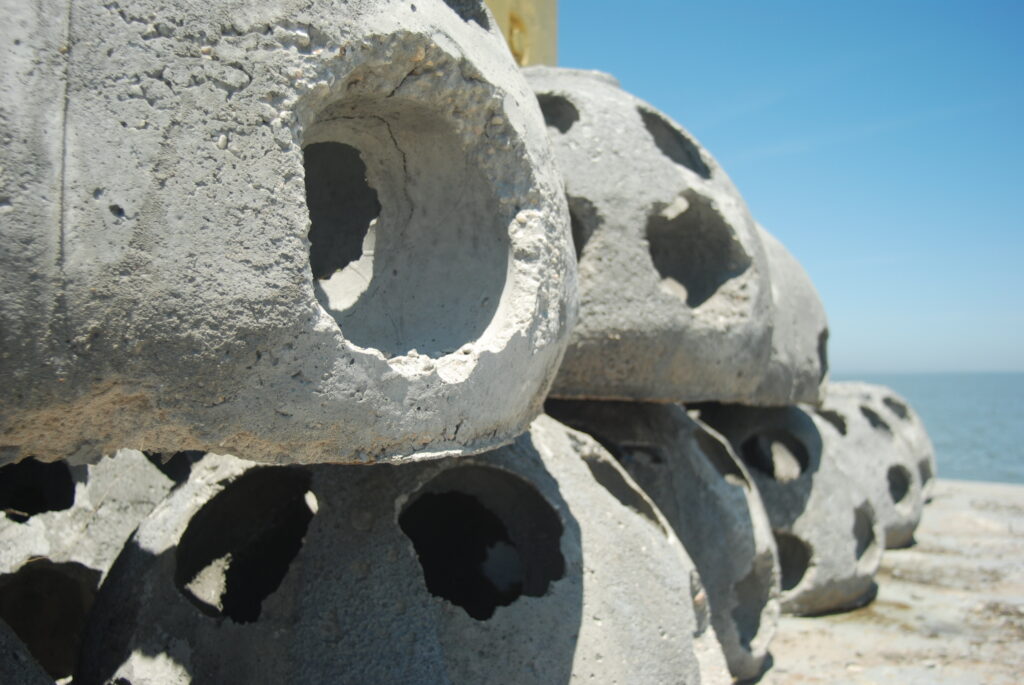
Living shorelines are not an all-or-nothing approach, and more extensive infrastructure can be added to the project if necessary. Harder elements, such as reef balls, sills, jetties, or breakwaters, can provide extra protection against wave action while the softer components establish themselves.
Some of the materials used in living shoreline construction are:
- Breakwater: Large freestanding rock structure placed offshore to soften waves before they reach shore.
- Edging: Natural materials, such as coconut-fiber logs, used to hold vegetated slopes in place.
- Fill: Sand added to rebuild gentle slopes and create elevation that supports marsh migration and plant growth.
- Jetties: Structures running perpendicularly from the land to the water to control currents and keep channels open for navigation.
- Native vegetation: Marsh grasses and plants that take root and help keep sediment from eroding.
- Reef Balls: Artificial concrete spheres designed to mimic the look and function of real coral by dissipating wave energy and providing habitat for small marine animals.
- Sill: A structure built parallel to the shore made of rock or bagged oyster shells that help stabilize sediment for vegetation and disperse wave energy.
New and innovative living shoreline techniques continue to develop as the practice becomes more commonplace, such as the novel “living seawalls” installed in Boston in 2024 to help marine life flourish on otherwise inhospitable infrastructure. Another effort in Maine tested the usage of old Christmas trees to prevent the erosion of sand dunes. Living shoreline practices vary by region; areas with natural coral reefs and mangroves often prioritize techniques to protect and restore existing intact habitats.
Advantages of Living Shorelines
Gray infrastructure varies fundamentally from living shorelines in that, on the day construction is completed, the structure is the strongest it will ever be. Conversely, in a living shoreline, the coastline is at its weakest right after natural elements and materials are implemented. Living shorelines build up, becoming stronger and more resilient over time, while hard infrastructure erodes and weakens as it absorbs continuous wave energy.
That gives living shorelines an advantage when it comes to cost effectiveness. NOAA reported that living shorelines typically cost less than hardened shorelines, for both installation and maintenance. Gray infrastructure needs to be replaced after decades of wear and tear and requires constant monitoring for structural issues. Living shorelines primarily take care of themselves but do require minimal stewardship of the land removing debris, replanting vegetation, replacing sand fill, and ensuring that elements remain in place.
Research has indicated that shorelines with intact wetland ecosystems are more resilient to storms than hard structures, according to NOAA. In fact, after Hurricane Sandy, The Nature Conservancy reported that nearly $430 million in additional damage was prevented in New Jersey due to the presence of healthy wetlands.
“Living shorelines are better at absorbing and dissipating kinetic wave energy that comes with bigger storm events,” said NEIWPCC Director of Water Quality Richard Friesner.
They also offer a variety of other co-benefits that can strengthen the ecosystem, improve biodiversity, and increase beach access. Coastal wetlands can improve water quality by filtering runoff; capturing and storing carbon; attracting new wildlife to the area; and protecting the community from storm surge by storing floodwaters. Additionally, living shorelines can improve recreational usage by adding green space to the area, improving local fisheries, and providing improved access to the coast.
Living Shorelines in the Northeast
While the usage of living shorelines in the Northeast is increasing, projects remain relatively uncommon in comparison to other parts of the country. That is partly due to increased physical challenges associated with the area such as winter ice, short growing seasons, large tidal ranges, strong wave energy, and variable coastal geology conditions that can complicate the planning process.
Other challenges that projects in the area face are complicated permitting processes, a lack of previous project designs to reference, and an overall misperception that hardened infrastructure provides better protection than natural elements.
Nevertheless, many projects located in parks, public areas, and private homes and businesses have found regional success over the last decade. Below is an example of shoreline stabilizations completed in each state:
Connecticut:
In 2014, the Stratford Point Living Shoreline (Stratford) became one of the first projects to be completed in the area. Using a variety of artificial shellfish reefs, smooth cordgrass marsh, and high marsh and coastal dune habitats, the project provided nearly 750 feet of erosion control and acres of restored coastal habitats.
Massachusetts:
Salem Sound Coastwatch led a volunteer effort in 2019 to plant 15,000 marsh grass plugs behind an already present rock sill in Collins Cove (Salem). The plantings were held in place by coir logs, sand fill, and biodegradable blankets. The goal of the project was to make the area more resilient to flooding.
Maine:
In an effort to prevent erosion at Maquoit Bay Conservation Land, which supports important plant and animal species, the town of Brunswick created a hybrid experimental living shoreline in 2020. The site placed dead oyster shells, half in bags and half in synthetic mesh baskets, to stabilize the shoreline. As Maine faces harsh winter conditions, the project tested the use of 10-foot-long tree trunks to provide a ramp for ice during the winter. The site has seen mixed results, and monitoring is still underway.
New Hampshire:
In 2019, the Wagon Hill Farm Living Shoreline was constructed to control erosion caused by heavy foot traffic in Durham, which is on the Great Bay. The design included a stone and tree root wad sill, adding fill to restore salt marsh, ensuring gradual upland slop for marsh migration, native marsh plantings, and fencing to reroute walkways. This living shoreline was the first of its kind in the state.
New York:
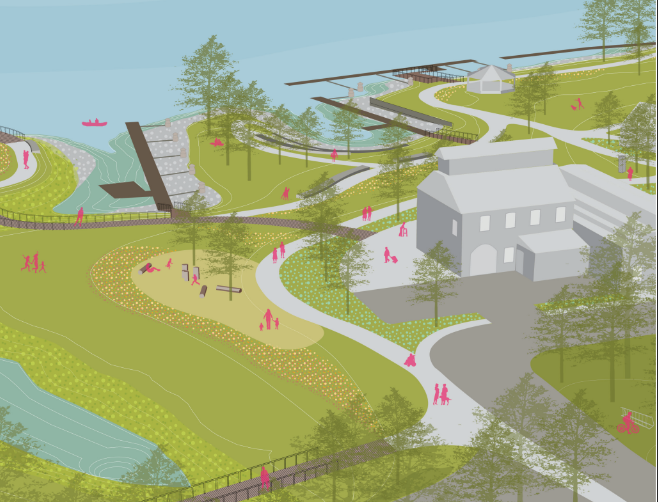
The New York State Department of Environmental Conservation, in partnership with NEIWPCC and the Hudson River Estuary Program, funded a redesign of the Henry Hudson Riverfront Park in Hudson to help it adapt to future sea level rise. The project includes a living shoreline component, where a gradient of species on a slop will be planted to slow erosion and allow for future wetland migration. The project, completed in 2025, also added a filtration garden to improve water quality and improved public access for the park.
Rhode Island:
The Nature Conservancy and the Coastal Resources Management Council installed a living shoreline at Rose Larisa Park in East Providence in 2020. Elements used in the project included an inter-tidal sill, plantings reinforced with biodegradable materials, and the restoration of a salt marsh.
Vermont:
The Vermont Department of Environmental Conservation, with funding support by NEIWPCC’s Lake Champlain Basin Program, manages the Lake Wise Program: a free, non-regulatory technical assistance looking to establish a new culture of lakeshore landscaping among lakeshore homeowners. The initiative aims to move current development practices away from clearing shores and building sea walls to offering nature-based solutions for controlling erosion.
Looking Forward
As the Northeast approaches 15 years since Hurricane Sandy made landfall, more living shorelines are beginning to take root across the Northeast. These projects will allow researchers to monitor their effectiveness in this region. Future designs will be able to learn from the successes — and flaws — of these initial efforts to improve future strategies.
Completed projects also provide blueprints for those looking to design living shorelines in the future, so they do not have to repeat the same research. Additionally, with each project completed, permitting agencies will gain a better understanding of their cost and effectiveness and can simplify the process of breaking ground on a project.
Living shorelines provide an opportunity to not only establish protection against future storms and erosion but also develop a better relationship between the coastline and its residents. Natural elements and restored wetlands provide habitat to bring back plant and animal species that have been decreasing for decades. Additionally, areas with living shorelines have the potential to support recreational activities by improving fisheries, protecting water quality, and preventing erosion of frequently used areas.
The management of living shorelines also offers an opportunity for community members to get involved and learn about the role of nature in protecting coastlines. Many projects have reached out to local students to participate in the upkeep of native plants. These experiences give them the opportunity to see first-hand how the process works, so they will walk away realizing that nature offers some of the best protection we have.
“Living shorelines offer a more natural process that is better in the long run,” said Friesner. “And let’s face it, they are prettier to look at as well.”